Phased Re-entry for Residents of Summerland
Check the address lists to determine whether you are included in the phased re-entry
Before you make plans to return home, please confirm that your address falls within the current re-entry area — boundaries can change as conditions on the ground evolve, and not every part of the community may not be cleared for re-entry at the same time.
District of Summerland - Transition from Evacuation Order to Prohibit Entry Order
Tuesday, September 29, 2026
The EVACUATION ORDER issued by the District of Summerland for the properties listed below is being transitioned to a PROHIBIT ENTRY ORDER, effective September 30, 2026, at 12:00 p.m. (noon).
❌ 13611 Cartwright Avenue
❌ 14605 Cartwright Avenue
❌ 14612/14614 Garnet Avenue
❌ 18420 Garnet Valley Road
❌ 19008 Garnet Valley Road
❌ 19154 Garnet Valley Road
❌ 20245 Garnet Valley Road
❌ 21207 Garnet Valley Road
❌ 21603 Garnet Valley Road
❌ 22797 Garnet Valley Road
❌ 23411 Garnet Valley Road
❌ 25600 Garnet Valley Road
❌ 26405 Garnet Valley Road
❌ 27006 Garnet Valley Road
❌ 27218 Garnet Valley Road
❌ 27413 Garnet Valley Road
❌ 28000 Garnet Valley Road
❌ 28818 Garnet Valley Road
❌25208/25210 Wildhorse Road
❌ 25804/25808 Wildhorse Road
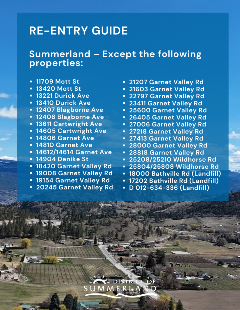
Familiarize yourself with the Re-Entry Guide before returning to your property
The re-entry guide contains important information to help you safely return home following the threat of wildfire. While returning home may bring a sense of relief, it is important to take the necessary precautions. Being prepared and proceeding carefully will help protect you, your family, and your property during re-entry.
This re-entry guide includes information on:
- Returning to your property
- Mental Health Support
- District of Summerland Utilities
- Food Safety
- Solid Waste
- Curbside Collection
- Wildlife Activity
- BC Transit Info
Please take the time to review the information provided before and during your return home. Conditions may have changed, and hazards may remain in some areas.
Stay informed through the Emergency Operations Centre at 250-490-4225 or eocinfo@rdos.bc.ca, or by signing up for VoyentAlert! here.
Please see the following Re-Entry Guides:
August 21, 2026
August 20, 2026
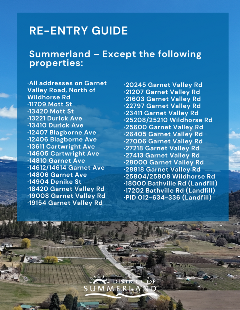
August 18, 2026
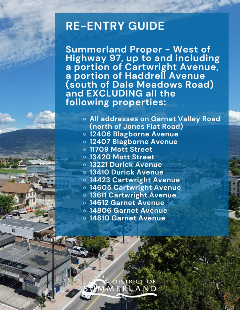
August 16, 2026
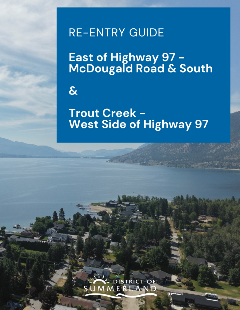
August 14, 2026
.tmb-small.png?Culture=en&sfvrsn=6515c7fb_1 "Teal Photo Nonprofit Impact Report (1)")
We know how difficult it is to be away from your home, and returning you safely is our top priority. Re-entry for the Bald Range Wildfire is being coordinated through the Regional Emergency Operations Centre (EOC), working with the District of Summerland, BC Wildfire Service, utility providers, health authorities and other partner agencies.
Re-entry will happen in phases, area by area, and only once BC Wildfire Service and the EOC confirm it is safe. A phased approach lets crews restore essential services and clear hazards in each area before residents return, rather than reopening the whole community at once.
Because conditions can change quickly, timelines cannot be guaranteed. We will update this page and our official channels as soon as new information is confirmed.
Reconnaissance (Level 2) Post Wildfire Natural Hazard Risk Analysis Report
Click here to read the Reconnaissance (Level 2) Post Wildfire Natural Hazard Risk Analysis Report for the following 2026 fire: Bald Range Fire K51490.
NOTE: This report is a preliminary reconnaissance assessment and is intended to identify potential post-wildfire natural hazards and risks that may require further investigation. It is not a detailed, site-specific risk assessment, and further work or additional information may alter the conclusions. Not all post-fire hazards, elements at risk, or fire-affected areas have been evaluated in detail. See Appendix A for important limitations and contact the author for more information.
Updated Geotech memo supplementary to all geotechnical assessments below:
Geotech Memo_ Revised Rainfall Criteria_2026-09-25_Rev 1
Geotech Assessments
Re-Entry Considerations for Public Safety & Services
The process of safely reopening an evacuated neighbourhood after a wildfire involves much more than simply putting out the flames. Before residents can safely return home, the Emergency Operations Centre works directly with BC Wildfire, the District of Summerland and partner agencies to mitigate and reduce immediate risks and hazards through a variety of safety checks. This section broadly explains that work so you know what stands between being evacuated from your neighbourhood and receiving the “all clear” to return home.
Fire and Environmental Safety
Response crews must first:
- extinguish fires in the immediate area
- identify and deal with any hidden underground hot spots
- identify and mitigate any immediate hazards such as fire-weakened hazard trees and unstable slopes
- complete rapid damage assessments on any properties that have been impacted directly from the fire event, with either partial or total structure loss
Critical Utilities
Utility teams must first:
- repair downed power lines and restore electricity to the area
- identify time periods of power outages, which may be different for various streets in each evacuated area
- assess and restore water, sewer and gas systems to ensure they can be brought back online
- issue or communicate boil water notices
- identify an immediate location for temporary garbage disposal due to the ongoing fire suppression at the Summerland landfill
- reestablish curbside collection to assist residents with disposal after being away from their properties for extended periods of time
Roadways and Access
Crews must first:
- identify and inspect damaged roads, bridges, culverts
- remove any debris, trees, power lines, equipment and abandoned vehicles from roadways to ensure emergency vehicles have unhindered access
- establish safe access and egress points into each re-entry area to enable orderly evacuation should the fire situation change
- establish new security checkpoints to enable residents to access approved areas
- ensure the new checkpoints are adequately staffed by the RCMP/security and have the information as to who is now permitted to re-enter the area
- install signage to identify new traffic patterns and speed changes
- barricade any unsafe roads, lanes, trails, and bridges
- work with BC Transit to re-establish public transit to the area
Information to Affected Residents
Communications must first be established to:
- provide timely updates on the initial emergency evacuation as well as the general process for the future re-entry and recovery of the affected area
- inform affected residents of partial or total structure loss and if safe, enable a controlled tour of the affected area to directly-impacted residents
- create tailored re-entry information packages with specific information to each approved area identifying such things as: power loss timelines, temporary curbside collection schedules, air quality information, mental health supports, assistance for livestock/crops, temporary transit schedules
Essential Services
Partner agencies and businesses must be contacted to:
- Verify on-scene availability of RCMP, fire protection, and ambulance services
- Coordinate with Interior Health (IHA) regarding the status of major care facilities
- Enable early accesses for businesses where possible to confirm local commercial readiness for groceries, fuel, and pharmacy services.
- Mobilize mental health support teams, including Emergency Support Services
Recovery and clean-up resources
As the evacuation orders are being downgraded to alerts and areas are opened up for re-entry, the initial emergency response effort will shift to a recovery effort. Further supports will be identified in the days to come, to help residents and business rebuild.
Should I be concerned about air quality in the Summerland area, especially since there is a fire at the landfill?
Exposure to smoke from both wildfires and landfill fires can affect health. Based on information available at this time, the fire is affecting areas of the landfill containing organic materials. The smoke from this fire would be similar in nature to that of the wildfire smoke already present in the area. Air quality impacts from wildfire smoke and other combustion sources can vary depending on weather conditions, fire behaviour, and local smoke concentrations.
Air quality monitoring and public advisories are managed by the Province of British Columbia through its air quality monitoring network. People who are more likely to experience severe and long-lasting impacts are those with pre-existing lung or heart conditions, pregnant people, infants and young children and the elderly. Check local air quality (AQHI or Aqmap) frequently to adjust your activities.
When air quality is affected by smoke, keeping the indoor environment as smoke-free as possible is the best way to protect health.
- Close windows and doors if possible to do so without overheating.
- Run portable air cleaners, DIY air cleaners or other air filtration systems to clean out any smoke that gets indoors. Focus on keeping the air in at least one room clean if it’s not possible to clean the air in the whole home.
- Spend time in public spaces, such as libraries and shopping malls where air tends to be cleaner and cooler
- Reduce time spent outdoors and avoid strenuous activities. The harder you breathe, the more particles you inhale.
- If you must be outdoors, consider wearing a well-fitted N95 or equivalent respirator to filter out smoke.
- Monitor symptoms of people in your care and yourself, seek prompt medication attention if severe symptoms occur, such as shortness of breath, chest pain, severe cough, dizziness and heart palpitations.
The Ministry of Environment and Parks and BC Wildfire Service are coordinating to review localized smoke forecasting information for the area. Additional information will be shared if conditions change.
BC Wildfire Service Information About Retardant & Suppressants
RETARDANT
Type of retardant used:
- The BC Wildfire Service currently uses Phos-Chek LC-95A.
- The liquid concentrate is delivered to our airtanker bases and mixed with water at a ratio of 5.5 parts water to 1 part LC-95A before it gets loaded into an airtanker.
- Perimeter Solutions is the company that provides the retardant. Further information is attached to this email from Perimeter Solutions - an information sheet and toxicological and environmental safety sheet.
How BC Wildfire Service uses retardant:
- Fire retardants are used to support ground crews in containing a fire by reducing the fire intensity and slowing the rate of spread.
- Retardants are water-soluble and contain ammonium salts that affect the burning process of forest fuels. When flames come into contact with retardant, the resulting reaction releases a combination of water and carbon dioxide that helps cool and suffocate the fire.
- Water-soluble fire retardants are commonly used in fire suppression because of their long-lasting effect on fires. Retardant is effective after it is dry and for as long as it remains on the fuels. Retardant has a much longer-lasting effect than water in fire suppression because it does not evaporate.
- Retardant can be applied adjacent to, or ahead of, an advancing wildfire by:
- Airtankers with tanks that can drop retardant
- Helicopters equipped with buckets that dip out of a large retardant tank
- Ground crews from bladders using pumps and hoses
Environmental considerations:
- The BC Wildfire Service prioritizes the protection of areas with high environmental values, such as community watersheds or habitats for species at risk. It is our policy not to release or drop fire retardant where it can enter a body of water.
- Nearly 90% of the retardant solution is water. The main active ingredient in the retardant utilized by the BC Wildfire Service is ammonium polyphosphate fertilizer. Fire retardants also contain small quantities of performance additives, including the use of iron oxide (rust) to colour the retardant mixture red to increase its visibility for air crews and ground personnel.
- The actual retardant components that are present in the solution are eventually consumed by plant life and provide nutrients to the plants. The gum thickener and other inorganic compounds are biodegradable and will break down via other means in the environment.
- Retardant and foam products used in B.C. are evaluated by the USDA National Technology and Development Program and must appear on their Qualified Product List. Among other testing, they are evaluated for mammalian and fish toxicity before being approved. https://www.fs.usda.gov/rm/fire/wfcs/wildland-fire-chemicals.php
Cleaning/removing wildland fire retardant products from surfaces:
- The following are suggestions for cleaning surfaces, such as buildings, homes and vehicles that have been coated with wildland fire retardant products:
- Start cleaning as soon as safety permits. The longer the retardant dries, the more difficult it is to remove completely.
- For smaller and/or more sensitive surfaces, the use of warm water, mild detergent and a soft brush or cloth followed by a clean water rinse is recommended. A presoak can also be helpful in softening the dried on material before brushing off.
- For larger surfaces, pressure washers have been used very effectively. Caution should be observed when using pressure washers on porous surfaces (e.g. stucco) - minimize the power of the spray so as not to loosen the stucco or drive retardant particles deeper into the surface.
- Each type of surface will have different characteristics and may be more or less difficult to clean. Surfaces that are porous such as concrete, stucco and stone are often more difficult to clean. Smooth surfaces like glass, metal and hard plastic are often easier to clean.
- Applied fire retardants do not pose a significant risk to humans, pets, wildlife, aquatic life or plant life. Wet retardant and runoff may be slippery, exercise caution when walking in it. Runoff from cleaning operations will often retain a significant red colour. Avoid draining into ditches or streams that run into natural waterways. Check with your local authorities for preferred methods.
SUPPRESSANTS
Background on suppressants and their use:
- Suppressants are water, with or without additives, and can cool the fire environment to reduce fire behaviour. They are not used to put out fires, but rather to cool them and slow their progress. Additives to water are essentially water modifiers (thickeners or foaming agents) which permit a thicker layer of water to coat the fuel, thereby increasing the time and energy required to vaporize the water. Surfactants in foam break down the surface tension of water droplets allowing the water to better penetrate the fuel. Once these products have evaporated, suppressant action ends.
- Suppressants are used to suppress or extinguish wildfires. They can be applied by ground crews using water bags, tanks, pumps and hoses, or by helicopters equipped with buckets or belly tanks. From time to time as deemed appropriate, water scooping aircraft (known as skimmers) are utilized and may be deployed anywhere in the province. These aircraft may come from companies in B.C., or from other jurisdictions through mutual aid agreements and are capable of injecting additives if needed.
Foam Mixtures
- Foam is dropped from the air by skimmers or land-based airtankers and usually extends over a wide area to help reduce the spread of the fire.
- Foam is water with an additive similar to dish soap and is applied to fires to slow their growth. Its composition will absorb heat from combustion through evaporation while its bubble structure slowly releases water to be absorbed by wood fuels. Foam improves the effectiveness of water in two ways: it helps the water soak deeper and quicker into forest fuels and slows down the evaporation of the water within them.
- Depending on the ratio of water to foam concentrate, the resulting mixture is either a “dry” or “wet” foam. Dry foams have smaller, high-insulation bubbles that offer greater heat absorption, while wet foams have larger bubbles that allow water to penetrate forest fuels more easily. Wet foams are generally considered to be more effective fire suppressants because dry foams are difficult to apply effectively (often getting caught in wind currents or tree canopies).
Type of foam used by BCWS:
- PHOS-CHEK WD881
- This is a "Class A” foam used for vegetative fires and may differ from the foam products used for non-vegetative fires.
- The Province follows the applicable regulation set out by the Ministry of Environment and Parks and the manufacturers' safety data sheet.
Perimeter Solutions retardant toxicological-and-environmental-safety-q-a 1
Perimeter solutions retardant_fact_sheet 1