Electric Vehicle Charging Stations

Electric vehicle (EV) ownership is rising in B.C. and all levels of government are supporting this clean-energy technology as drivers choose to go electric for affordability, lifestyle, and doing their bit for the environment.
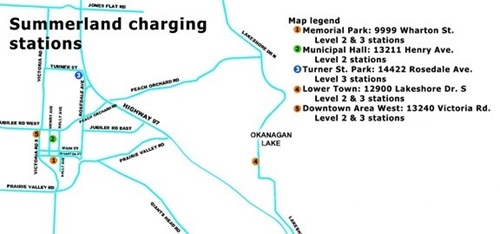
The District of Summerland is investing in the electric future and now offers public EV charging at five locations across the community, including fast chargers (Level 3). Our chargers are conveniently located throughout the community so that EV drivers can go shopping, grab a bite to eat, or walk along the Okanagan Lake while their vehicle charges.
Using Summerland’s chargers is easy. Watch the video below for more information:
Summerland also permits low-speed electric vehicles on roads within the District with speed limits under 50km/hr (Low-Speed Electric Powered Vehicle Authorization Bylaw).
Charging Etiquette
There is some etiquette that EV owners should abide by for the consideration of others.
1. When you‘re done, put the charging cord away so people don‘t trip or drive over it. And please keep the station tidy.
2. If you are at a Fast Charger (Level 3), consider limiting your charging time to around 30 minutes. Your charging speed will slow down anyway as you get closer to full. Fast Chargers are the most popular and not taking too long is courteous to others who are likely waiting.
3. You don‘t have to stay at your car while charging but do monitor the status through your charging app, and move your vehicle once finished.
4. Don‘t unplug others, unless there is a note that gives you permission to do so.
Frequently Asked Questions
What maintenance is required on an EV?
What are the different types of EVs?
Are there EV trucks or EVs with 4x4?
What happens if I ever run out of power?
What maintenance is required on an EV?
An EV driver saves on average approximately $2,000 per year in fuel and maintenance.
Electric vehicles require a fraction of the maintenance when compared to internal combustion engine (ICE) vehicles. ICE vehicles have 2000 plus parts whereas EVs have about 200. There are no timing belts, exhaust systems, O2 sensors, spark plugs, engine air filters, oil changes, or even a transmission! The brakes on an electric vehicle rarely, if ever, need replacing due to less wear using regenerative braking.
Tires and wiper blades are the regular maintenance items on EVs.
The highest-cost potential replacement item on an EV is the battery pack. Most EVs come with a five to eight year, or 160,000 km powertrain, warranty. The cost of a new battery varies by model and manufacturer, but replacing a battery will typically run into the thousands of dollars. If you need battery work, individual cells can often be replaced for significantly less than the cost of the entire pack. Plus, the prices of batteries, which makes up to about a third of the vehicle cost, are dropping every year.
What are the different types of EVs?
Battery Electric Vehicles (BEV)
Also known as fully electric, these EVs run on a rechargeable battery and recharge by plugging into a wall outlet or charging station. They also recharge their batteries when you drive downhill or stop through regenerative braking (read more about that further down.)
Plug-in Hybrid Electric Vehicles (PHEV)
Plug-in hybrids are similar to full electric vehicles but have a lower range on electric and switch to a gas engine when the battery is low. People often get a PHEV to do their daily commute on electric (about 47km) but have the gas option for longer trips. Plug-in hybrids also have regenerative braking. Read Summerland resident Natalie's story on her experience with a PHEV.
Hybrid vehicles (HEVs)
Not to be confused with the previous plug-in hybrid vehicles, straight hybrids cannot be recharged. These were made popular by the second generation Toyota Prius in the early 2000s. Their gas and electric drive systems run simultaneously and although they often have a small battery, they are not considered a true electric vehicle. They also have regenerative braking.
Fuel Cell Electric Vehicle (FCEV) / Hydrogen EVs
This is new technology and while fuel cell vehicles are expected to grow in popularity, as of 2021, there are only three models available — the Hyundai Nexo, Honda Clarity, and the Toyota Mirai.
They are refuelled at public hydrogen stations, similar to pumping gas. Their batteries charge by converting hydrogen to electricity. They only takes a few minutes to refuel, have a range of about 600 km, and are zero-emissions, emitting only water from the exhaust.
There are a limited number of public hydrogen refuelling stations in B.C. currently, with more under construction. There are four stations in B.C. (Vancouver, Burnaby, North Vancouver and Victoria) and additional stations including Kelowna are planned. In September 2020, the Government of B.C. announced $10 million towards construction and operation of 10 stations and Hydrogen B.C.
Are there EV trucks or EVs with 4x4?
There are no trucks yet, but they're coming! GMC's hummer is expected in late 2021 and Ford is creating an electric F-150, plus others are expected shortly also.
You can take your EV on a dirt road, and as there are fewer components, there is less to worry about breaking. Many EVs do come with 4x4 capability and enough power for towing. See more here.
What happens if I ever run out of power?
Electric vehicles can charge from any electrical outlet so the likelihood of completely running out of power is slim. The ever-expanding charging network of public chargers on highways and in communities mean there is usually always an option to charge, and apps such as A Better Route Planner calculate the best places for you to charge based on your vehicle type and your destination.
If you do run out of electricity and aren’t able to recharge, contact your breakdown provider and ask for a flatbed truck to take you to a nearby charging station. Electric vehicles shouldn't be towed with a rope or lift, as this can damage the traction motors that generate electricity through regenerative braking.
Want More Information?
Check out our brochure Why Go Electric? All the Reasons to Drive an EV in Summerland. Printed copies are available at Municipal Hall.
Plug In BC provides information and support around plug-in vehicles and charging throughout British Columbia.