Agricultural Water
NOTICE - As per Council resolution (April 1), the District of Summerland is currently at Drought Level 3 – Very Dry Conditions under the Summerland Drought Response Plan.
As a result, water allocations have been reduced by 20% as follows:
- Agricultural, cemetery, parks, playfields, and golf courses: 800 mm → 640 mm
- Greenhouses: 1,727 mm → 1,382 mm
Water users are encouraged to review their anticipated needs and plan accordingly for the upcoming season, as the District works to protect long-term water supply and maintain environmental flows.
The District will continue to provide updates as conditions evolve.
Visit our 2026 Drought Response webpage for more information.
---
With extensive consultation with agriculturalists, water utility experts and the community, the District of Summerland implemented a tiered rate model for irrigation to encourage responsible water use. It is based on the premise that those users who exceed the threshold will pay an inclining tiered rate.
It is important that you understand this rate model as it may affect how you water, how much you water, and how much you pay for water.
Who does this affect?
This rate model affects all agricultural water utility accounts that are on the Irrigation Roll.
Consumption Reports
Reports provide consumption in imperial gallons, cubic meters, depth in inches and depth in millimetres for agricultural water customers for the following:
- Monthly consumption
- Year-to-date cumulative consumption totals
- Annual consumption thresholds
Properties can be identified on the consumption reports by individual meter number. Please refer to the District's letter dated April 2, 2026, which provides each customer with their meter number.
Link to the
Consumption Reports.
When will this affect me?
Depending on how much water you use, it may affect your water utility bills. If you have concerns regarding the impact of this model, please contact us for further discussion.
How much will I pay for water?
How much you pay for water depends on how much water you use and how much arable area is on your property.
The rate model allots water based on arable area on an annual basis, as follows:
2026 Rates
| Category |
Base Fee (per acre of arable area) |
Threshold (depth of water allotted) |
|
|
$261.67
|
800 mm per arable acre |
- Cemetery, Park, Playfield
- Golf Course
|
$288.63 |
800 mm per arable acre |
|
|
$593.20 |
1727 mm per arable acre |
A depth of 800 mm of water is roughly equal to 3,237 cubic meters, 712,040 imp. gallons, or 2.62 acre feet, per arable acre per year.
If you use more water than the threshold, you will pay an inclining tiered consumption fee for all water in excess:
| Category |
Percent Over Threshold |
Rate (per cubic meter) |
- Agricultural
- Cemetery, Park, Playfield
- Golf Course
- Greenhouse
|
1-20%
21-40%
41-60%
61-80%
81% and over |
$0.33
$0.66
$1.32
$2.64
$5.28
|
What should I do?
If you remain under the threshold: You will pay only the Base Fee, which is calculated on the arable area of land on your property. There’s nothing for you to do other than keep using water responsibly. Your bill for the season’s water use will be mailed to you at the end of July.
If you go above the threshold: You will pay both the Base Fee and Consumption Fees. The Base Fee will be billed at the end of July, and your Consumption Fees will be billed at the end of the growing season. The more you use above the threshold, the higher the rate will go. Here are some ways you may be able to reduce how much you pay in Consumption Fees:
- Examine your watering practices and irrigation technologies and then modify where possible to improve efficiency and reduce waste.
- Confirm that your arable area is correct – if the actual arable area on your property is greater than what the District has on record, your threshold will be incorrectly calculated and you’ll be paying too much in Consumption Fees.
The District will work with you to address each of these situations on an individual basis.
Arable Area
The District of Summerland accepts applications for increases in arable area (i.e. new arable land, independent of the review). The property owner will be responsible for all costs related to the installation of new water connections, or upgrades to existing connections including the cost to determine if sufficient water is available at the location if required.
There is also a water utility buy-in fee of $5,497.90 per arable acre. This fee funds Summerland’s water utility infrastructure.
|
Where can I learn more about this rate model or correct the District’s records?
You can find out more about this change or correct the District’s records (e.g. update arable acreage) by contacting the District's Meter Technician/Clerk, Andrew Richmond, at 250-404-4038 or arichmond@summerland.ca.
Accounts identified as likely to greatly exceed the water allotment threshold will be individually contacted by District staff to discuss possible causes and available options to correct or minimize your costs.
How do I read the water meter myself?
Your agricultural water meter records consumption in cubic meters (m³). To read it, open the hinged cover to expose the display. It will activate when exposed to adequate light. Consumption is displayed down to the nearest thousandth of a cubic meter. For a visual guide, please refer to the image below:
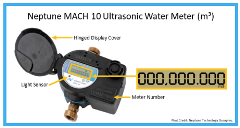
To calculate your water usage, subtract the reading from the previous month from the current reading. Please see the following example:
Example
Previous Month Meter Read: 1,400.000 m³
Current Month Meter Read: 5,900.150 m³
5,900.150 m³ – 1,400.000 m³ = 4,500.150 m³
If you wish, you can convert your water consumption to Imperial Gallons by multiplying by 219.969: 4,500.150 m³ X 219.969 = 989,893.495 Imperial Gallons
FAQ - Agricultural Water User Questions
Q: How can I plan and manage my water use if my annual water allotment may change at any time during the irrigation season?
A: Plan conservatively, monitor usage regularly, and be prepared to adjust practices if drought conditions worsen. Your Allocation will likely change through the 2026 season. Read your 2026 Agricultural Water letter and understand how to read your water meter.
Q: Agricultural irrigation meters are read monthly. If the annual water allotment is reduced during the season, will additional meter readings or usage reports be provided to help farmers track their water use?
A: No. Account holders have the ability to read their meters at any time. Read your 2026 Agricultural Water letter and understand how to read your water meter.
Q: What happens if drought restrictions reduce my annual water allotment and I have already used more than the new limit? (e.g., sudden reductions causing someone to be instantly over their allotment)
A: Plan conservatively, monitor usage regularly, and be prepared to adjust practices if drought conditions worsen. Your Allocation will likely change through the 2026 season. Seasonal usage is assessed at the end of the irrigation season and billing for water will be calculated using the Allocation at the time of irrigation turnoff. See Water Utilities Bylaw Schedule A for water rates.
Q: Why is the annual agricultural water fee not reduced when water allotments are restricted?
A: Fees support the operation and maintenance of the water system and are not directly tied to annual usage levels. The District does not sell water, it charges water users for its costs related to storage, treatment, distribution and maintenance or improvement of infrastructure.
Q: How will I be notified if my allocation changes?
A: The main method of communication is through VoyantAlert. Please follow the steps at this weblink to signup (https://voyent-alert.us/community/).
Q: Are reductions mandatory at Drought Level 2?
A: No. At Drought Level 2, reductions are voluntary, with a target of about 10%. At this stage the focus is on awareness and conservation, not enforcement. Mandatory reductions only start if the District moves to Drought Level 3 or 4.
Q: If it’s voluntary, will I be billed at the reduced allotment?
A: No. Allocations and thresholds in Level 2 are used as a conservation, planning and education tool. If you follow the voluntary reduction, you may be more prepared for future mandatory and larger reductions.
Q: How does billing work if drought levels change?
A: If drought conditions worsen during the season and Council moves to Drought Level 3 or 4 this summer, allocations would experience compulsory restrictions. In that case, the final seasonal billing would be calculated using the lower allocation associated with the higher drought level. Because total seasonal consumption is assessed at the end of the irrigation season, water used earlier in the year would still count toward the revised allocation, which may result in some users exceeding the lower threshold and being billed at higher rate tiers.